
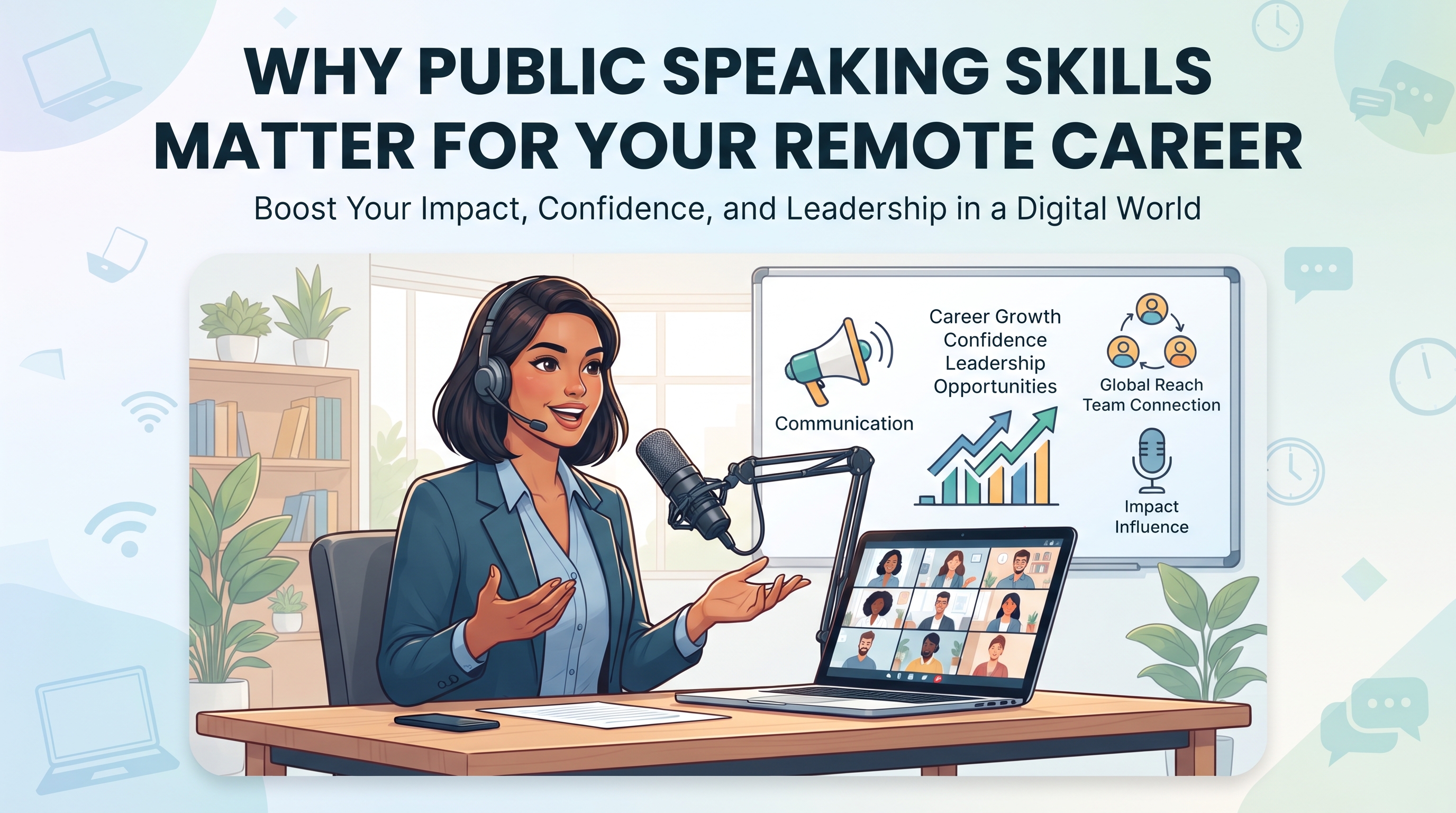
Why This Skill Matters More, Not Less, Remotely
In an office, a lot of communication happens informally, hallway conversations, body language, casual clarification. Remote work strips most of that away, which means the moments where you do speak, a video call, a recorded presentation, a client pitch, carry more weight and less room for the informal follow-up that used to smooth over unclear communication.
This is exactly why public speaking and presentation skills have become more, not less, relevant for remote professionals. Clear, confident communication is one of the few things that reliably signals competence across a screen.
The Skills Worth Building
Presentation design teaches you to structure information so it lands clearly, not just correctly. Storytelling is a genuinely persuasive technique, people remember and act on stories far more than they remember raw information delivered flatly.
Audience engagement, reading whether people are actually following and adjusting accordingly, matters even more on video calls where visual cues are harder to read. Persuasive communication and handling Q&A confidently round out a practical toolkit for anyone who needs to represent ideas clearly at work.
How VAA Global's Public Speaking Course Builds This
VAA Global's Public Speaking and Media Communication course runs 10 weeks, covering presentation design, storytelling, audience engagement, persuasive communication, and handling Q&A, with real practice and feedback built into the structure, not just theory.
This course pairs well with almost any other skill you're building, since confident communication amplifies the value of whatever else you know. Every VAA Global course includes a 2-month internship, 2 certificates, and job placement assistance.
The Research Behind Communication and Career Growth
Harvard Business Review has repeatedly published research linking strong communication skills directly to leadership advancement, finding that technical competence alone rarely predicts who gets promoted into higher-visibility roles, clear communication consistently does.
If you're building this alongside a specific career skill, take the free Career Compass quiz to see how it fits with courses like PR and Corporate Communications or Corporate Branding.
Common Mistakes Beginners Make in This Field
A common beginner mistake is over-preparing a word-for-word script and then sounding robotic when delivering it, rather than internalising key points and speaking more naturally around them. Audiences respond far better to genuine, slightly imperfect delivery than to a stiff, memorised recitation.
A second mistake is ignoring audience engagement entirely, delivering a presentation as a one-way broadcast rather than reading the room and adjusting. Watching for confusion or disengagement and responding to it in real time is what separates a good speaker from a merely rehearsed one.
A third mistake is avoiding Q&A preparation, treating it as an afterthought when it's often where a presentation's credibility is actually tested. Anticipating likely questions beforehand builds genuine confidence for that moment.
What Your First Few Weeks Actually Look Like
Early weeks in VAA Global's Public Speaking course focus on presentation design and structuring information clearly, building the foundation before worrying about delivery polish.
The middle weeks bring in storytelling techniques and real practice delivering, with feedback. The final weeks cover handling Q&A confidently, before the 2-month internship gives you real opportunities to apply it.
It's also worth understanding that discomfort before speaking rarely disappears entirely, even for experienced speakers, what changes with practice is your ability to perform well despite that discomfort, not the elimination of nerves altogether, which is a more realistic and achievable goal to actually work toward.
This same discipline, showing up and delivering despite discomfort, is exactly the muscle that structured, repeated practice sessions are designed to build, which is why consistent weekly practice tends to outperform occasional, high-pressure attempts at improvement.
Beyond the specific techniques taught, this course also deliberately puts you in front of low-stakes practice audiences repeatedly, since the confidence that actually transfers to a real, high-stakes presentation comes from accumulated repetition, not from a single well-crafted speech memorised for one occasion.
VAA Global Talent at talent.vaaglobal.tech is specifically built to connect graduates like you with employers actively hiring for these roles.
When you're ready to start applying, VAA Global's free CV and LinkedIn review tool at vaaglobal.tech/cv-review is worth using to make sure your application actually lands well.
Research from LinkedIn Hiring Insights backs this up, consistently finding that this pattern holds across the wider remote job market, not just as an isolated trend.
Gallup Workplace Research has tracked this pattern closely, and their findings reinforce exactly the point made here.
Building Real Confidence
Confident communication is a trainable skill, not a personality trait you either have or don't. If you're ready to build it deliberately, you can apply to VAA Global's Public Speaking course.