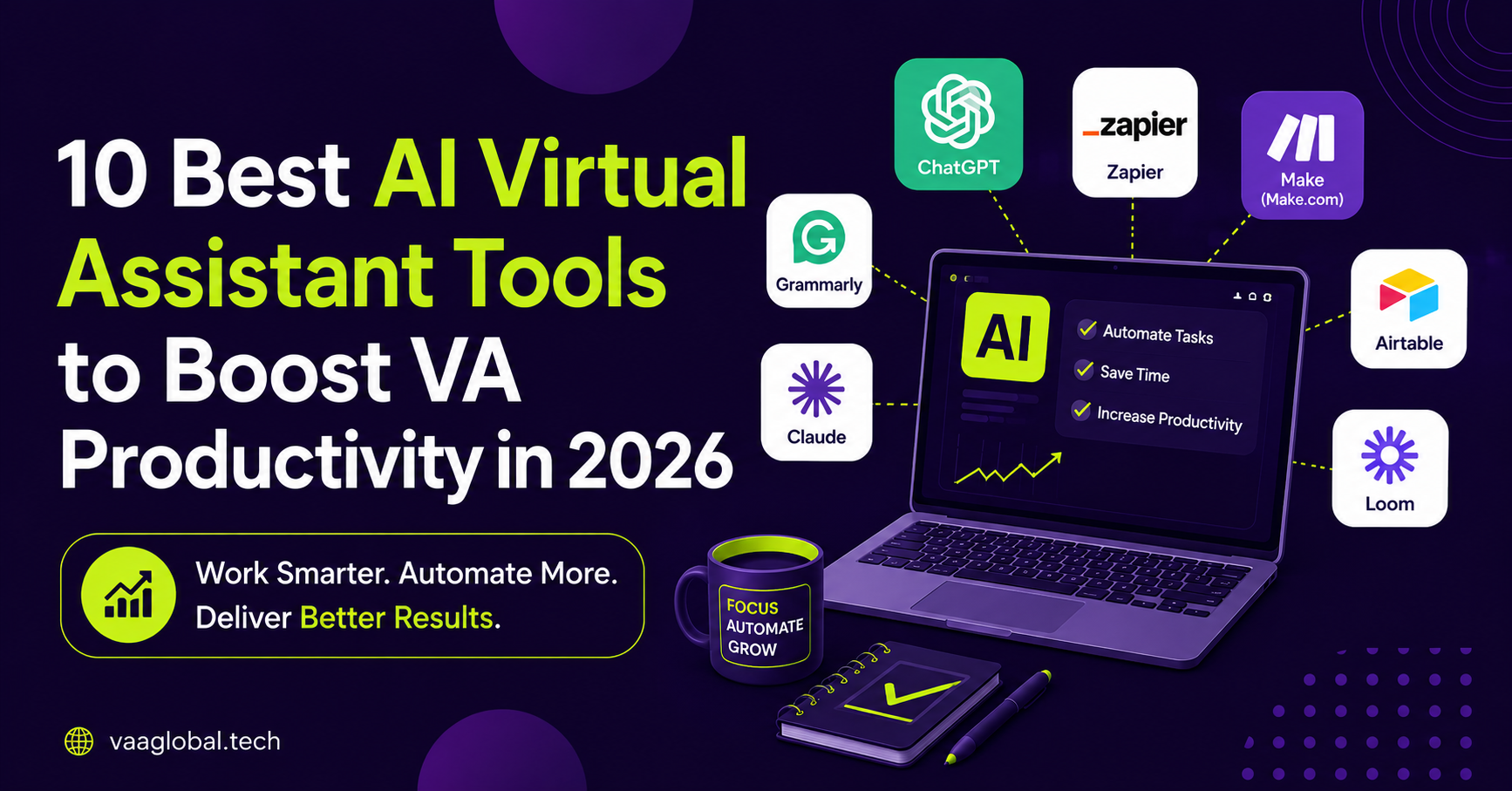
AI virtual assistant tools are helping modern virtual assistants complete tasks faster, improve accuracy, and deliver better results for clients. In 2026, VAs who understand tools like ChatGPT, Zapier, and Make.com have a stronger advantage because they can automate repetitive work and focus on higher-value activities.
The role of a virtual assistant is changing. Clients are no longer only looking for someone who can complete tasks. They want professionals who can use technology to improve workflows, save time, and increase efficiency.
This guide covers the best AI tools for virtual assistants, how they work, and how you can use them to become a more productive and valuable VA.
What Are AI Virtual Assistant Tools?
AI virtual assistant tools are software platforms that use artificial intelligence to help virtual assistants complete tasks more efficiently. These tools support areas such as content creation, research, communication, automation, scheduling, and business operations.
Instead of spending hours completing repetitive tasks manually, VAs can use AI to speed up their workflow while still applying human judgment and creativity.
Common uses include:
- Writing and editing content
- Creating client reports
- Managing emails
- Automating workflows
- Summarising meetings
- Organising information
- Improving client communication
AI does not replace the skills of a virtual assistant. Instead, it helps professionals work smarter and provide more value.
How Is AI Changing Virtual Assistance in 2026?
AI is changing virtual assistance by making everyday tasks faster and more efficient.
For example, a VA creating a weekly newsletter can use AI to generate a first draft, improve the structure, and suggest ideas within minutes. A task that previously took an hour can now be completed much faster with the right process.
As a result, AI-skilled virtual assistants can support more clients, offer additional services, and position themselves for better opportunities.
1. ChatGPT for Writing, Research, and Content Support
ChatGPT is one of the most useful AI tools for virtual assistants. It helps VAs create content, organise information, and complete writing-based tasks more efficiently.
Virtual assistants use ChatGPT for:
- Drafting professional emails
- Creating social media captions
- Writing reports
- Summarising documents
- Creating SOPs
- Generating content ideas
- Conducting research
However, getting quality results depends on the instructions you provide. This skill is called prompt engineering.
What Is Prompt Engineering?
Prompt engineering is the ability to create clear instructions that guide AI tools to produce better results.
A strong prompt usually includes:
- The role the AI should take
- The background information
- The expected format
- The preferred tone and style
For example:
"You are a virtual assistant supporting a real estate company. Write a professional follow-up email for a client who attended a property viewing. Keep the tone friendly and professional."
Clear prompts help virtual assistants create better outputs with less editing.
VAA Global’s AI programme teaches practical AI skills, including prompt engineering and automation tools.
2. Zapier for Workflow Automation
Zapier is an automation tool that connects different applications and helps businesses reduce manual tasks.
Virtual assistants use Zapier to create automated workflows such as:
- Adding new leads to spreadsheets
- Creating tasks from emails
- Sending automatic reminders
- Updating customer records
- Connecting forms with business tools
For example, instead of manually copying information from a form into a spreadsheet, Zapier can complete the process automatically.
This allows VAs to spend more time on important client tasks.
3. Make.com for Advanced Automation
Make.com helps virtual assistants create more advanced workflows between different platforms.
While simple automation tools handle basic tasks, Make.com allows professionals to build detailed systems involving multiple steps.
VAs can use Make.com for:
- Client onboarding workflows
- Marketing processes
- Data management
- Business operations
- App integrations
Learning automation platforms can help virtual assistants move beyond basic support roles and offer higher-value services.
4. Grammarly for Better Client Communication
Strong communication is one of the most important skills for any virtual assistant.
Grammarly helps improve written communication by checking:
- Grammar
- Spelling
- Sentence clarity
- Professional tone
For VAs managing emails, documents, and client messages, this ensures every communication looks professional.
5. Loom for Client Updates
Loom allows virtual assistants to create short video explanations for clients.
Instead of writing long messages, a VA can record a quick walkthrough showing:
- Completed tasks
- Project updates
- Process explanations
- Recommendations
This improves communication and helps clients understand the work being completed.
How to Use AI Tools as a Virtual Assistant
To get the most value from AI tools, virtual assistants should combine technology with strong professional skills.
Here are practical steps:
-
Learn the right AI tools
Start with tools like ChatGPT, Zapier, Make.com, Grammarly, and Loom. -
Practice using AI in daily tasks
Apply AI to writing, research, organisation, and workflow management. -
Create examples of your AI skills
Build portfolio samples showing how you use AI to improve processes. -
Position yourself as an AI-powered VA
Highlight your ability to save time and improve client operations.
Clients value VAs who can solve problems, not just complete instructions.
How AI Skills Help Virtual Assistants Earn More
The demand for AI-literate virtual assistants is increasing because businesses want professionals who can improve efficiency.
A VA who understands automation, AI writing tools, and digital workflows can provide more value than someone offering only basic administrative support.
Instead of positioning yourself as:
"I am a virtual assistant who completes tasks."
You can position yourself as:
"I help businesses improve operations using AI tools, automation, and efficient workflows."
This communicates a stronger business impact.
VAA Global helps students develop modern remote work skills through practical training programmes in virtual assistance and AI.
Best AI Virtual Assistant Tools to Learn in 2026
The most valuable tools for virtual assistants include:
- ChatGPT for writing and research
- Zapier for automation
- Make.com for workflows
- Grammarly for communication
- Loom for client updates
Learning these tools can help you work faster, improve your service quality, and compete for better remote opportunities.
Final Thoughts
AI virtual assistant tools are becoming essential skills for professionals who want to succeed in the modern remote work industry.
The future of virtual assistance belongs to people who combine human skills with technology. By learning AI tools, automation, and better workflows, VAs can deliver better results and create more value for clients.
Start building your AI-powered VA skills with VAA Global's Virtual Assistance Certification Program.